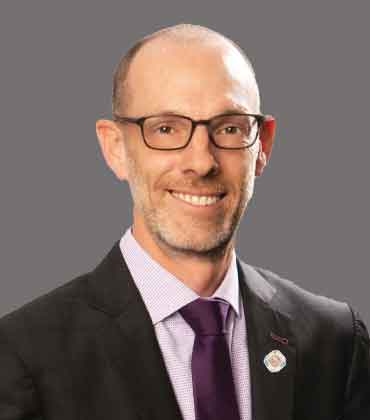
A career spanning law, state government and local leadership has shaped Justin Jones’ broad view of public service. A longtime attorney and former Nevada state senator, he brings that experience to the region’s hardest problems— infrastructure, land use, transportation, housing and economic development—with a practical understanding of how policy affects people.
“At its core, local government is about problem-solving and finding common ground.” Over the past eight years, this ethos has guided Jones’ decisions as commissioner of one of Clark County’s fastest-growing areas, and as a leader on the boards of regional agencies that build and operate Southern Nevada’s backbone infrastructure. That principle has shaped Jones’ efforts to advance economic diversification in the region, modernize Southern Nevada’s transit and infrastructure network and expand mental health programs.
Building the Infrastructure for Growth
Housing sits at the top Jones’ priority list. The county’s affordable housing shortage is longstanding, and Jones has responded by pushing for funding for affordable community housing projects, creation of a community land trust, and successfully advocating for land use policies that pair transit and housing.
Managing growth also means creating an economy that can support the people and businesses that call the region home. Southern Nevada’s economy runs on tourism—an asset Jones wants to keep building on. As the county’s longtime representative on the regional economic development board, he has also helped lead a yearlong strategic planning effort to diversify the region’s economic base and attract new businesses while strategically leveraging the tourism industry already anchoring it.
Diversifying also meant building institutions the county didn’t have. When he joined the County Commission, Clark County had no economic development department nor a redevelopment agency. Working with fellow commissioners, he helped reestablish the redevelopment agency and expand its footprint, including the Spring Mountain Chinatown Corridor. Jones also led the county’s creation of its Office of Community and Economic Development, which has advanced an innovation district overlay around the UNLV Tech Park and master planned for new industrial park in his district, along with innovative small businesses grant programs.
There is so much opportunity over the next two decades to really make this the community that we want it to be.
Transportation carries similar growth pressure. Jones chairs the Regional Transportation Commission of Southern Nevada, which functions as transit manager, traffic manager and metropolitan planning organization all at once. As chair, Jones has led the agency through funding challenges and legislative wins and is now working with key industry stakeholders to update RTC’s long-range infrastructure investment plan. He has worked with RTC leaders to expand transit service across the valley while preparing for autonomous vehicles and public-private projects such as the Boring Company Loop and Brightline West high-speed train.
This year, the region opened its first all-electric bus rapid transit line, running along Maryland Parkway from the airport to the Las Vegas Medical District, the kind of high-capacity transit Jones wants to see expand further.
Expanding Access to Care
Southern Nevada’s growth hasn’t stopped at roads and rooftops. It has also placed pressure on the region’s capacity to care for residents in crisis. With one of the lowest ratios of mental health providers to residents, Jones has worked to address the shortage with state and local partners. These efforts helped stand up a 988 crisis call center, a crisis stabilization center and mobile crisis teams that respond directly to residents facing a mental health or substance use crisis.
Diversion programs give the county another way to reach people proactively. Jones and the regional Criminal Justice Coordinating Council use them to connect people involved in the justice system to behavioral health care and sustainable housing. Prioritizing prevention runs through the rest of Jones’ approach to public service. As he puts it, ‘the government has to stay focused on the people it exists to serve.’
Planning for What Lasts
During his tenure, Clark County adopted its first climate action plan and expanded its environmental functions through the Department of Environment and Sustainability. Those changes fed into Transform Clark County, the county’s comprehensive planning initiative, which incorporated sustainability principles into the development code. For Southern Nevada, those considerations are inseparable from water and Jones has been a leader on the board of the Southern Nevada Water Authority, which is actively negotiating, and litigating, the region’s supply under the next Colorado River operating guidelines.
Preserving Red Rock Canyon and expanding access to public lands has also remained a priority. The county has partnered with the Bureau of Land Management and other federal agencies on the Red Rock Legacy Trail, extending recreation access even as development continues nearby. Because most land in the county is federally managed, Jones has also engaged closely in federal lands legislation that will shape where the valley grows next.
Leading Through Listening
Jones’ approach to all of it, from housing and transit to mental health and conservation, has been shaped by his years in law and public service, where he learned to see issues from different perspectives and find common ground. His advice to other public officials comes back to serving the people. Residents on the ground understand their challenges better than officials do, he believes. That conviction is why regular meetings with constituents and stakeholders have remained central to his work over the past eight years.
As Southern Nevada keeps expanding, Jones wants sustainability and new urbanist principles built into how it grows next. The county’s busy international airport is due for renovation over the next decade, additional stadiums are likely to come online and new residents keep arriving daily, each one reinforcing the need to plan growth in the right way and ensure people have access to transportation and housing options. Jones is treating the next two decades as Clark County’s chance to become the ideal community for its residents—the one he wants it to be.