

Thank you for Subscribing to Gov Business Review Weekly Brief

Transport Canada [TSX: TRP]
Jamie Johnson, Regional Director of Civil Aviation
Organizational Safety in Aviation
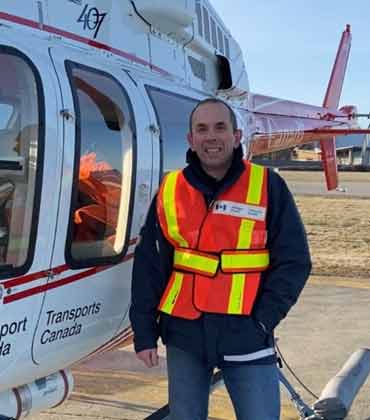
Jamie Johnson
After a 20-year career as an Engineer Officer in the Royal Air Force, Jamie spent the next ten years as a Program Director in the aerospace industry, working for Marshall Aerospace and the IMP Group. He became Regional Director for the Pacific Region in 2018. Jamie holds an MSC in aircraft design and lives with his family in Victoria.
Aviation accidents are rarely just the results of the actions of an individual or the failure of a single system. Usually, they are caused by sequences of events that have their genesis in organizational culture. Whether I knew it or not, I have been in the safety business since first arriving on an operational Royal Air Force (RAF) Tornado GR1A Squadron in 1991. However, I don’t think I had ever really considered aviation safety in the organizational sense until January 2005, when I found myself 25 miles Northwest of Baghdad, Iraq, beginning the accident investigation into the tragic loss of Hercules aircraft XV179. At the time, it was the UK’s biggest single loss of life during Op Telic. Sadly, only 20 months later, Nimrod XV230 crashed 10 miles South East of Kandahar, Afghanistan, with the loss of all 14 crew members. During the investigation into the loss XV179, we were drawn to the conclusion that the aircraft had been lost due to enemy action, but there were many indications of an overstretched organization and a degradation of the wider airworthiness system. However, in the case XV230, the internal investigation concluded the loss had been caused by airworthiness issues resulting in a dry bay fire, leading to a subsequent independent inquiry that focused on organizational issues. Led by Charles Haddon-Cave QC, the Nimrod Review was published in October 2009 and is available in the public domain. If you are a senior leader in the aviation industry, then the Nimrod Review is an essential read, not just because of the consideration of events surrounding XV230 but also because Haddon-Cave revisits other major inquests into accidents with organizational causes. While I wholeheartedly agree with the analysis and conclusions of the report, as somebody who was there at the time, I can see that it is very much the viewpoint of somebody on the outside looking in rather than the inside looking out. In aviation, we are often victims of our own success, having achieved remarkably low accident rates. This can lead us, if not to complacency, then at least to an assumption that we are ‘safe anyway’; a kind of success that has engendered optimism. Hadden-Cave became a little too focused on the failures of individuals and a general malaise in the system. In my experience, it’s not quite what I have seen, either in civil or military aviation. In practice, a ‘can do’ attitude and a willingness to continue to operate with an over-stressed system are usually the better places to look for the root causes of organizational accidents. At the time of the loss of XV230, we were simply spread too thin and fighting on too many fronts, but it is easy to draw parallels to today’s civil aviation industry grappling with both pandemic recovery, marginal economics, and a widespread skills shortage. In aviation, leaders can be drawn away from safety as they focus on other priorities necessary to steer their organization through difficult circumstances; there is no great Machiavellian plot to ignore safety nor any lack of overall effort by leaders.If as an industry we want to learn from our past mistakes, we should all heed the words of James Reason, who stated that “If you are convinced your organization has a good safety culture, you are almost certainly mistaken.
The articles from these contributors are based on their personal expertise and viewpoints, and do not necessarily reflect the opinions of their employers or affiliated organizations.
