

Thank you for Subscribing to Gov Business Review Weekly Brief


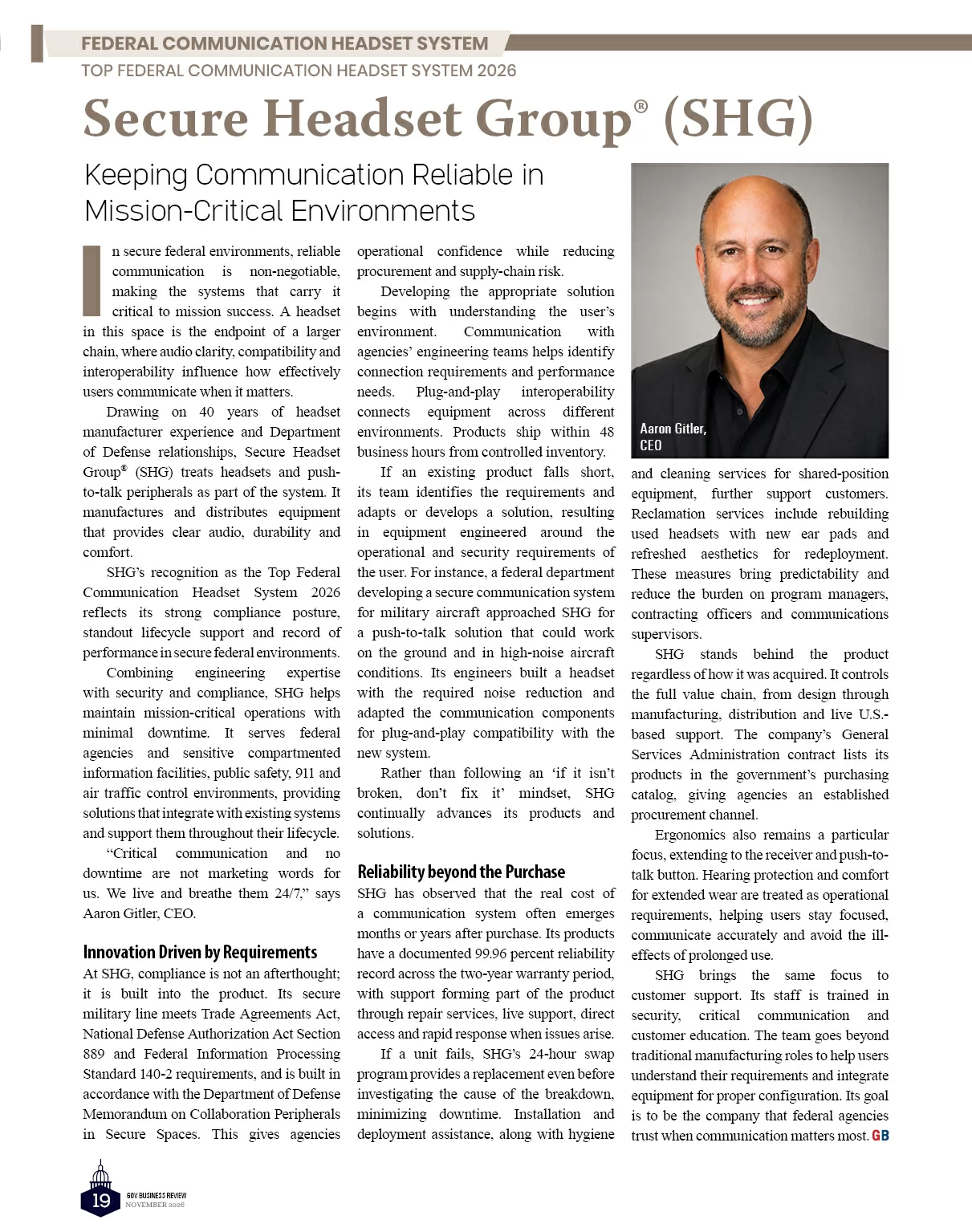
 Aaron Gitler, CEO
In secure federal environments, reliable communication is non-negotiable, making the systems that carry it critical to mission success. A headset in this space is the endpoint of a larger chain, where audio clarity, compatibility and interoperability influence how effectively users communicate when it matters.
Drawing on 40 years of headset manufacturer experience and Department of Defense relationships, Secure Headset Group® (SHG) treats headsets and push-to-talk peripherals as part of the system. It manufactures and distributes equipment that provides clear audio, durability and comfort.
SHG’s recognition as the Top Federal Communication Headset System 2026 reflects its strong compliance posture, standout lifecycle support and record of performance in secure federal environments.
Combining engineering expertise with security and compliance, SHG helps maintain mission-critical operations with minimal downtime. It serves federal agencies and sensitive compartmented information facilities, public safety, 911 and air traffic control environments, providing solutions that integrate with existing systems and support them throughout their lifecycle.
“Critical communication and no downtime are not marketing words for us. We live and breathe them 24/7,” says Aaron Gitler, CEO.
Innovation Driven by Requirements
At SHG, compliance is not an afterthought; it is built into the product. Its secure military line meets Trade Agreements Act, National Defense Authorization Act Section 889 and Federal Information Processing Standard 140-2 requirements, and is built in accordance with the Department of Defense Memorandum on Collaboration Peripherals in Secure Spaces. This gives agencies operational confidence while reducing procurement and supply-chain risk.
Developing the appropriate solution begins with understanding the user’s environment. Communication with agencies’ engineering teams helps identify connection requirements and performance needs. Plug-and-play interoperability connects equipment across different environments. Products ship within 48 business hours from controlled inventory.
-
Critical communication and no downtime are not marketing words for us. We live and breathe them 24/7.
If an existing product falls short, its team identifies the requirements and adapts or develops a solution, resulting in equipment engineered around the operational and security requirements of the user. For instance, a federal department developing a secure communication system for military aircraft approached SHG for a push-to-talk solution that could work on the ground and in high-noise aircraft conditions. Its engineers built a headset with the required noise reduction and adapted the communication components for plug-and-play compatibility with the new system.
Rather than following an ‘if it isn’t broken, don’t fix it’ mindset, SHG continually advances its products and solutions.
Reliability beyond the Purchase
SHG has observed that the real cost of a communication system often emerges months or years after purchase. Its products have a documented 99.96 percent reliability record across the two-year warranty period, with support forming part of the product through repair services, live support, direct access and rapid response when issues arise.
If a unit fails, SHG’s 24-hour swap program provides a replacement even before investigating the cause of the breakdown, minimizing downtime. Installation and deployment assistance, along with hygiene and cleaning services for shared-position equipment, further support customers. Reclamation services include rebuilding used headsets with new ear pads and refreshed aesthetics for redeployment. These measures bring predictability and reduce the burden on program managers, contracting officers and communications supervisors.
SHG stands behind the product regardless of how it was acquired. It controls the full value chain, from design through manufacturing, distribution and live U.S.-based support. The company’s General Services Administration contract lists its products in the government’s purchasing catalog, giving agencies an established procurement channel.
Ergonomics also remains a particular focus, extending to the receiver and push-to-talk button. Hearing protection and comfort for extended wear are treated as operational requirements, helping users stay focused, communicate accurately and avoid the ill-effects of prolonged use. Its goal is to be the company that federal agencies trust when communication matters most.
Choosing Federal Headsets for Secure Communication
Federal headset procurement breaks down when a device is treated as an accessory instead of part of the communications chain. A unit may sound acceptable in isolation yet create approval problems or compatibility gaps once introduced into a secure workspace. The expense is rarely limited to replacement hardware. It appears in delayed deployment, repeated troubleshooting, user workarounds and avoidable downtime. Federal buyers should judge the headset system by how well it fits the security environment around it, not by headset specifications alone.
Procurement discipline starts with origin and federal eligibility, not model comparison. TAA status and Section 889/NDAA alignment can affect whether a device is suitable for purchase and deployment. FIPS 140-2 requirements may also shape equipment choices in protected environments. Consistency matters here. A supplier that treats compliance as a federal-only variant can create unnecessary supply-chain questions later. Buyers need documentation that remains clear across procurement and replacement cycles, particularly when the same equipment may be deployed across multiple locations. Documentation must also be usable by contracting personnel and technical reviewers, since a headset may clear one purchasing gate yet still fail a deployment review.
Compatibility deserves equal scrutiny as federal environments rarely offer a blank slate. Headsets and push-to-talk peripherals must match the communications system already in place and the connection method it accepts. A credible provider should be able to work through interface requirements before shipment and modify a design when a standard configuration does not fit. That matters when agencies modernize one layer of a communications stack without replacing everything around it. Product availability also counts because a technically correct configuration loses value if replenishment takes too long.
Long shifts expose another purchasing risk. Speech intelligibility and hearing protection should be evaluated together. Comfort deserves its own test over extended wear. Small design choices become consequential when a user handles the same equipment for hours. Microphone behavior, receiver quality, ear pressure and push-to-talk actuation can affect how consistently the device is used. A headset that demands frequent adjustment adds friction at the endpoint, even when the larger communications system is performing as intended.
“Secure Headset Group® (SHG) backs deployments with live support, repair services, a 24-hour swap program and a two-year warranty.”
Post-sale support is part of the buying decision rather than an administrative detail. Live technical help and advance replacement can shorten the gap between failure and restored use. Repair capacity also changes lifecycle economics, especially when equipment can be returned to service instead of being discarded. Warranty terms should be read alongside inventory practices because replacement speed depends on whether stock is actually available. Federal purchasing also favors clear accountability. Contract access can simplify acquisition, but it should not substitute for a supplier that remains answerable when configurations change, or a field unit fails.
Secure Headset Group® (SHG) is the premier choice for agencies that need a federal communication headset system built around secure deployment rather than a stand-alone device. Its SM military headsets and push-to-talk peripherals address federal procurement requirements while the company works through compatibility details before deployment.
It backs deployments with live support, repair services, a 24-hour swap program and a two-year warranty. Its manufacturer-distributor model also keeps product accountability under one roof. For agencies weighing security fit against downtime exposure, that combination makes Secure Headset Group a practical recommendation rather than a hardware-only purchase.
...Read more
Federal Communication Headset Systems Info
Q1
What Do Federal Communication Headset Systems Need to Support in Secure Environments?
Federal Communication Headset Systems must do more than transmit speech. They need to preserve clear audio, connect reliably with existing communications equipment and meet the security and procurement requirements of the environment. In protected facilities, a headset and its push-to-talk peripheral form the user-facing end of a wider communications chain. Compatibility, durability, hearing protection and dependable support all affect whether personnel can communicate without interruption.
Q2
How Does Secure Headset Group Address Federal Communication Headset Systems Requirements?
Secure Headset Group (SHG) brings 40 years of headset manufacturing experience and established Department of Defense relationships to its work. It manufactures and distributes headsets and push-to-talk peripherals, treating them as integrated parts of a communications system rather than isolated accessories. Its secure military line is designed to meet Trade Agreements Act, National Defense Authorization Act Section 889 and Federal Information Processing Standard 140-2 requirements. SHG also works with agency engineering teams to identify connection and performance needs, then adapts or develops equipment when standard products do not fit the operating environment.
Q3
Why Does Interoperability Matter When Selecting Federal Headsets?
Federal Communication Headset Systems often need to work with equipment already installed, so buyers should assess connection types and interface requirements before procurement. A headset that performs well on its own can still create deployment delays if it cannot connect to the existing system or satisfy technical review. Plug-and-play compatibility, clear product documentation and the ability to adapt a configuration can reduce integration problems. These considerations are especially important when an organization updates one part of its communications infrastructure without replacing the entire system.
Q4
Which Performance Factors Affect Long-Term Headset Reliability?
Audio clarity is only one part of performance. Users may wear headsets for extended periods, making comfort, receiver quality, microphone behavior, push-to-talk controls and hearing protection relevant to daily use. Federal Communication Headset Systems should also be assessed for durability, repair options, warranty coverage and replacement availability. SHG reports a 99.96 percent reliability record across its two-year warranty period and supports products with repair services, live technical assistance and a 24-hour swap program. Such lifecycle provisions can help limit downtime when equipment fails.
Q5
How Can Federal Communication Headset Systems Be Matched to Specialized Operating Conditions?
The right configuration depends on the noise level, communications platform, security rules and tasks involved. A standard headset may not provide the noise reduction or connection method required in a particular setting. SHG describes working with a federal department on a push-to-talk solution for military aircraft, where equipment needed to function both on the ground and in high-noise flight conditions. Its engineers developed a headset with the required noise reduction and modified the communication components for plug-and-play compatibility.
Q6
What Should Agencies Consider Beyond the Initial Equipment Purchase?
Procurement teams should examine the support available after delivery, including installation assistance, repair turnaround, replacement stock and equipment refurbishment. Federal Communication Headset Systems have ongoing costs when failures interrupt work or units must be discarded rather than restored. SHG provides installation and deployment assistance, hygiene and cleaning services for shared-position equipment, and reclamation that refreshes used headsets for redeployment. Its products are also listed through a General Services Administration contract, providing an established government purchasing channel.
