

Thank you for Subscribing to Gov Business Review Weekly Brief


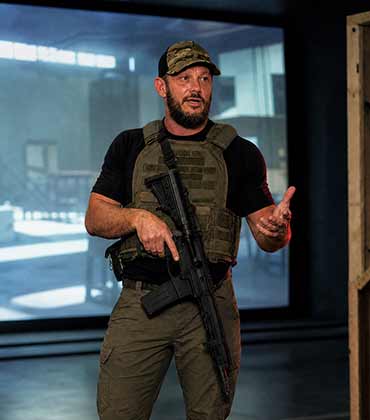 Wes Fox, CEO
In traditional firearms training, trainees shoot paper or steel targets under controlled conditions. While these exercises can improve marksmanship, they do little to prepare individuals for the stress, decision-making, communication and threat recognition required in real-world encounters.
United Defense Tactical (UDT) addresses this disconnect through immersive, reality-based threat training. It combines progressive skill development with scenario-driven instruction to develop dynamic-thinking survivors capable of assessing threats, making sound decisions and responding effectively in rapidly evolving situations.
UDT’s specialized training programs serve civilians, security professionals, law enforcement officers and military personnel.
“We prepare people with the skills, judgment and confidence needed to survive critical encounters,” says Wes Fox, CEO and founder.
Expertise-Driven Training Methodologies
UDT was founded to make communities safer by providing training for all experience levels, from first-time participants to elite professionals. To maintain integrity, it conducts rigorous participant screening and background checks.
The company’s diverse cadre of experts, including instructors and advisors who come from special operations forces, the military, law enforcement, SWAT units and competitive shooting, brings real-world experience that shapes practical programs. Fox and UDT’s chief tactics and programs officer, Ray Cash Care, play central role in shaping training methodologies, tactical curriculum and advanced programs. Fox developed UDT’s core progressive training curriculum, while Care, a former Navy SEAL and CIA master instructor, contributes decades of operational and instructional experience to the continued development of tactics and programs.
“Our mission is to develop professionals who can think, communicate and make the right decisions at the worst possible moment so they can protect those they serve and make it home safely to those they love,” says Cash.
Reality-Based Training for Dynamic Threats
UDT teaches a combination of lethal and non-lethal tactics, including firearms, Tasers, OC spray, batons and other tools used by law enforcement, military and security professionals. The training incorporates the OODA loop—observe, orient, decide and act—to develop the mental processes required.
Unlike training models built primarily around isolated courses or periodic qualifications, UDT’s integrated, progressive training system continuously builds tactical skills and real-world decision-making ability. Across eight progressive levels, participants advance from fundamental skills into increasingly complex applications integrating firearms, defensive tactics and combatives, less-lethal options, live role-play, force-on-force training and immersive scenario-based decision-making.
Training progresses into realistic environments and complex tactical problems involving close-quarters battle, home and building defense, vehicle defense, active-threat response and rapidly evolving encounters.
-
We prepare people with the skills, judgment and confidence needed to survive critical encounters.
Live role players, realistic environments, increasing scenario complexity and detailed after-action reviews require participants to apply what they have learned. rather than simply demonstrate individual techniques. This develops professionals who can think, adapt and effectively access their training when a real-world encounter becomes chaotic and uncertain.
Following each exercise, trainees undergo detailed after-action debriefings examining tactical decision-making, communication, threat identification, use-of-force considerations, articulation, legal implications and available alternatives. This teaches participants how to act, evaluate, explain and defend the decisions under pressure.
UDT also teaches advanced defensive tactics, drawing from the most effective techniques in police jiu-jitsu, grappling, control, restraint and other hands-on systems to help officers safely manage real-world encounters. By emphasizing control and de-escalation, it increases officer and suspect safety while providing alternatives to higher levels of force.
Expanding the Footprint of Tactical Preparedness
UDT is expanding facilities, capabilities and programs as it broadens access to reality-based training nationwide. It currently has 70 facilities in various stages of development, with 25 locations expected to be operational by the end of 2026.
By developing advanced custom simulator enhancements, proprietary training firearms, modular shoot-house systems and expanded scenario libraries, it is creating increasingly immersive environments.
It is also introducing new certification and training programs in executive protection and tactical emergency casualty care. The company is rolling out the HALO Church Security Program nationwide, helping houses of worship strengthen security.
UDT aims to make reality-based threat training more accessible through progressive, highly adaptable environments that mirror real-world encounters and prepare individuals to respond effectively under pressure.
Training for Decisions beyond the Range
Police training budgets often break down in the gap between controlled qualification and an encounter that changes by the second. A range score can confirm basic handling. It cannot show whether an officer can read distance, communicate under pressure or explain a use-of-force decision after the scene is over. That gap matters to command staff because missed judgment can carry legal exposure, public scrutiny, officer injury and civil claims long after the report is filed.
Procurement teams should look beyond the number of training hours on a proposal. The more useful question is whether the program creates decision pressure without creating unnecessary danger. Static marksmanship still has a place, but it should not be mistaken for preparation for crowded rooms, vehicle stops, confused bystanders or uncertain intent. Firearms instruction that never tests recognition and restraint leaves agencies paying for activity rather than readiness.
Good tactical instruction also needs a defensible feedback loop. Departments are not buying a motivational seminar. They are buying a controlled way to see how officers process a threat, how they communicate before force is used and how they describe the choices that followed. Scenario review and legal debriefing can turn training from a skills session into documentation of professional judgment. That matters for chiefs managing community trust as much as it matters for field supervisors reviewing performance.
Continuity is another dividing line. One-day courses can create a temporary lift, then fade before habits change. Smaller doses over a longer training arc fit policing better because skill retention depends on repetition under varied conditions. A department that treats firearms training as an annual compliance event may satisfy a file requirement while leaving officers underprepared for ambiguous encounters. A stronger program should build layers of judgment and control, then return officers to pressure often enough for those layers to hold.
The training environment should also reflect the full range of force decisions available to an officer. A provider that teaches only shooting narrows the decision tree. Agencies need practice space for communication, movement, restraint and less-lethal options because the best result is often a controlled arrest rather than a weapon discharge. Procurement should press for scenario design, instructor depth, measurable feedback and a structure that does not disappear after a single course date.
Scale has a quieter importance. Regional access and repeatable standards affect whether training survives staffing changes or becomes dependent on one favored instructor. Executives responsible for public safety purchasing should ask how the provider keeps instruction consistent across locations and adapts scenarios to department policy, including participant screening. Convenience alone is not enough, but avoidable travel friction can decide whether officers train once or return often enough to improve.
United Defense Tactical is a fitting recommendation for agencies that want firearms and tactical training tied to judgment rather than range repetition. Its model centers on reality-based scenarios, simulator environments, live role play and a progressive eight-level curriculum. The program also covers non-lethal tools, de-escalation, use-of-force articulation and law enforcement security pathways, giving departments a broader training arc than a stand-alone firearms class. For executives weighing civil exposure, injury reduction, training retention and field readiness, United Defense Tactical offers a practical fit because it connects weapon handling to decision-making under pressure.
...Read more
