

Thank you for Subscribing to Gov Business Review Weekly Brief


As communities expand into the Wildland Urban Interface (WUI), more homes, businesses and critical infrastructure are exposed to wildfire threats, making rapid structural protection a necessity. Wildcat Fire Services Inc. specializes in preparing and protecting these assets, even before an emergency call is received.
While suppression crews focus on containing the blaze, the Alberta-based company deploys highly trained crews and purpose-built structural protection systems for governments, emergency agencies and private-sector clients, helping safeguard vulnerable properties through the anxious period before flames reach them.
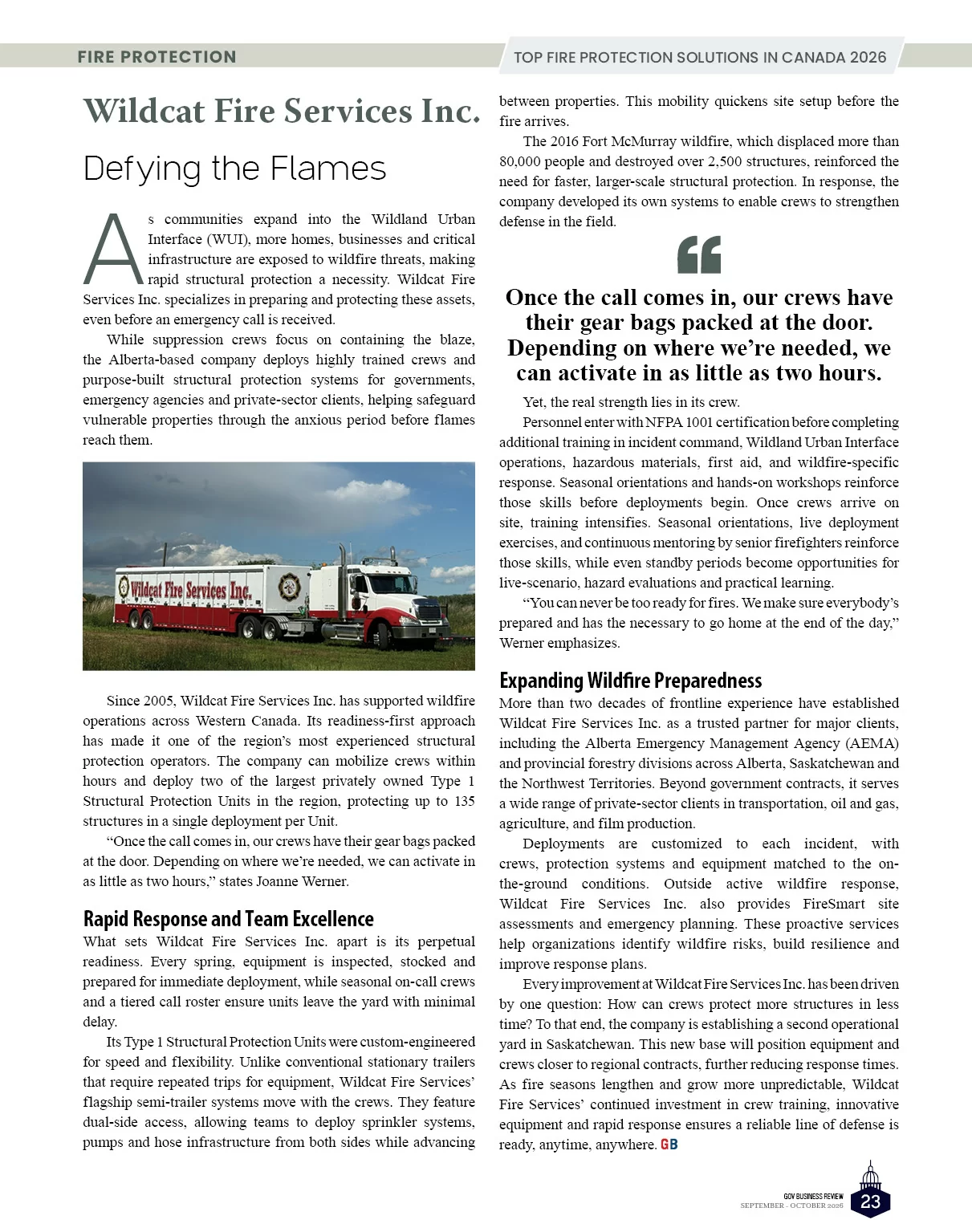
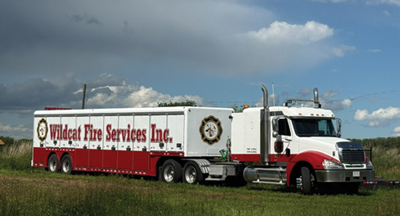 Since 2005, Wildcat Fire Services Inc. has supported wildfire operations across Western Canada. Its readiness-first approach has made it one of the region’s most experienced structural protection operators. The company can mobilize crews within hours and deploy two of the largest privately owned Type 1 Structural Protection Units in the region, protecting up to 135 structures in a single deployment per Unit.
"Once the call comes in, our crews have their gear bags packed at the door. Depending on where we're needed, we can activate in as little as two hours,” states Joanne Werner.
Rapid Response and Team Excellence
What sets Wildcat Fire Services Inc. apart is its perpetual readiness. Every spring, equipment is inspected, stocked and prepared for immediate deployment, while seasonal on-call crews and a tiered call roster ensure units leave the yard with minimal delay.
Its Type 1 Structural Protection Units were custom-engineered for speed and flexibility. Unlike conventional stationary trailers that require repeated trips for equipment, Wildcat Fire Services’ flagship semi-trailer systems move with the crews. They feature dual-side access, allowing teams to deploy sprinkler systems, pumps and hose infrastructure from both sides while advancing between properties. This mobility quickens site setup before the fire arrives.
-
Once the call comes in, our crews have their gear bags packed at the door. Depending on where we're needed, we can activate in as little as two hours.
The 2016 Fort McMurray wildfire, which displaced more than 80,000 people and destroyed over 2,500 structures, reinforced the need for faster, larger-scale structural protection. In response, the company developed its own systems to enable crews to strengthen defense in the field.
Yet, the real strength lies in its crew.
Personnel enter with NFPA 1001 certification before completing additional training in incident command, Wildland Urban Interface operations, hazardous materials, first aid, and wildfire-specific response. Seasonal orientations and hands-on workshops reinforce those skills before deployments begin. Once crews arrive on site, training intensifies. Seasonal orientations, live deployment exercises, and continuous mentoring by senior firefighters reinforce those skills, while even standby periods become opportunities for live-scenario, hazard evaluations and practical learning.
"You can never be too ready for fires. We make sure everybody's prepared and has the necessary to go home at the end of the day,” Werner emphasizes.
Expanding Wildfire Preparedness
More than two decades of frontline experience have established Wildcat Fire Services Inc. as a trusted partner for major clients, including the Alberta Emergency Management Agency (AEMA) and provincial forestry divisions across Alberta, Saskatchewan and the Northwest Territories. Beyond government contracts, it serves a wide range of private-sector clients in transportation, oil and gas, agriculture, and film production.
Deployments are customized to each incident, with crews, protection systems and equipment matched to the on-the-ground conditions. Outside active wildfire response, Wildcat Fire Services Inc. also provides FireSmart site assessments and emergency planning. These proactive services help organizations identify wildfire risks, build resilience and improve response plans.
Every improvement at Wildcat Fire Services Inc. has been driven by one question: How can crews protect more structures in less time? To that end, the company is establishing a second operational yard in Saskatchewan. This new base will position equipment and crews closer to regional contracts, further reducing response times. As fire seasons lengthen and grow more unpredictable, Wildcat Fire Services’ continued investment in crew training, innovative equipment and rapid response ensures a reliable line of defense is ready, anytime, anywhere.
Fire Protection Buying Under Wildland Interface Pressure
A fire protection purchase is no longer based only on the size of a provider’s equipment inventory. The key consideration is whether crews, engines, trailers and protection systems can reach and support a site before a fire threat escalates. Wildland urban interface risks have changed how communities and remote assets across Western Canada approach protection planning. Many locations now operate near wildfire-prone areas, while seasonal demand can stretch crews and equipment across large distances. When response and setup are delayed, crews may lose valuable time establishing protection, leaving owners, insurers, contractors and public agencies facing greater risk.
Dispatch speed matters, but speed alone is not enough without proper staging and coordination. Buyers need confidence that a provider can take a call, assess the situation and deploy the right resources without having to create a response plan from the beginning. Standby coverage demands a different level of preparation than immediate asset protection. Reliable service models keep crews prepared before a request comes in, ensure equipment is ready for deployment and maintain enough staffing capacity to manage absences without disrupting operations. Readiness in this field is built through established processes, maintained equipment, trained teams and routines that have been proven before a fire reaches the perimeter.
Equipment capacity creates another point of difference among protection providers. Smaller trailers may be suitable for limited areas with fewer structures, while larger risks often require systems that can be transported and deployed as crews work. What matters is not just the amount of equipment available, but how hoses, pumps, sprinklers, fittings and support tools are arranged for quick deployment. A well-designed trailer allows crews to unload, position and connect systems quickly instead of sorting through equipment on site. For buyers protecting cabins, commercial properties, public infrastructure or resource-sector assets, this approach can influence how much protection can be established before a fire reaches the area.
Training should be assessed with the same practicality. Fire protection crews need more than certificates on file. They need command awareness, interface-specific preparation, scenario practice and repeated handling of the equipment they will use under pressure. Seasonal staffing can work well when the provider treats readiness as a recurring process, not a hiring model. Orientation, live drills, pump practice, hazard checks and supervised field learning reduce the gap between classroom knowledge and field execution. Procurement teams should look for this level of preparation instead of relying only on response distance or equipment volume when evaluating providers.
Contract fit also matters when evaluating a provider. Government agencies, industrial operators, contractors and private asset owners all have different response expectations. Some need crews on standby as conditions change, while others require fast deployment and setup before a fire reaches their assets. A capable provider should understand those differences, define its responsibilities clearly and avoid overstating what it can control during a fire event.
Wildcat Fire Services Inc. provides fire protection support focused on rapid deployment, structural protection, trained crews and equipment ready for field operations. The company maintains privately owned value and structural protection units with inventory capable of protecting up to 135 structures at a time. Its equipment is organized for active deployment, allowing crews to move and set up systems rather than rely on static unloading. The model addresses practical operational needs through seasonal on-call readiness and a growing Saskatchewan presence designed to improve response times. For organizations facing wildland interface risks, Wildcat Fire Services Inc. offers a model worth evaluating.
...Read more
Fire Protection Solutions in Canada Info
Q1
What Do Fire Protection Solutions in Canada Cover During Wildfire Threats?
Fire Protection Solutions in Canada can include structural protection, mobile water and sprinkler systems, pumps, hose infrastructure, site assessments, emergency planning and trained field crews. During a wildfire, these resources can be deployed around exposed properties before flames arrive, helping create a defensive layer while suppression teams focus on containing the broader incident. Effective structural protection depends on readiness, mobility and the ability to adapt equipment and staffing to changing site conditions.
Q2
How Does Wildcat Fire Services Inc. Strengthen Structural Protection Readiness?
Wildcat Fire Services Inc. supports Fire Protection Solutions in Canada through a readiness model built for rapid deployment. The Alberta-based company has supported wildfire operations across Western Canada since 2005 and can activate crews in as little as two hours, depending on location. It also operates two large Type 1 Structural Protection Units, each capable of supporting protection for up to 135 structures during a deployment. That scale helps crews establish defenses across multiple properties without relying on smaller, repeatedly repositioned equipment loads.
Q3
What Equipment Capabilities Matter in Wildfire Structural Protection?
Fire Protection Solutions in Canada benefit from equipment designed for fast setup, movement and field flexibility. Mobile structural protection systems can help crews place sprinklers, pumps and hose networks where risk is highest, then adjust as conditions evolve. Dual-side equipment access can also reduce setup friction when teams are moving between properties. Beyond capacity alone, organizations should consider how quickly a system can be positioned, whether crews can work from it efficiently and how well it supports changing operational priorities.
Q4
How Do Fire Protection Services Support Risk Reduction Before an Incident?
Fire Protection Solutions in Canada are not limited to active wildfire response. Pre-incident work can include FireSmart site assessments, hazard identification and emergency planning that help organizations understand exposure before fire activity reaches a critical stage. This type of wildfire preparedness can support clearer response plans, better resource positioning and more informed decisions about vulnerable structures. A strong program connects preventive planning with operational readiness so protective measures can be activated quickly when conditions deteriorate.
Q5
How Does Wildcat Fire Services Inc. Prepare Crews for Complex Deployments?
Wildcat Fire Services Inc. makes sure its crews are well prepared for Fire Protection Solutions in Canada. Team members start with NFPA 1001 certification and get extra training in areas like incident command, Wildland Urban Interface operations, hazardous materials, first aid, and wildfire response. They also take part in seasonal orientations, practice deployments, and learn from experienced firefighters. During standby periods, crews get hands-on learning and assess hazards, which helps them stay ready for changing conditions during protection work.
Q6
What Should Organizations Evaluate When Choosing Wildfire Protection Support?
When assessing Fire Protection Solutions in Canada, organizations should look beyond equipment inventories and consider response speed, crew qualifications, deployment capacity, planning support and the ability to adapt to site conditions. Structural protection can require coordinated action before and during an incident, so service readiness matters as much as technical capability. Organizations should also examine whether a provider can support proactive risk assessment, field deployment and continued operational learning as part of one coherent wildfire preparedness approach.
